How does someone feel lonely while being deeply loved? How does someone feel unsupported while living in a joint family? Three recent studies from our team suggest that the answer may begin in childhood—and may even shape domains of life that seem unrelated to relationships, including how some men experience money.
I have asked people versions of this question for years now, across hundreds of consultations at our wellness centre in Ahmedabad. The answer is rarely “I don’t have enough people around me.” It is closer to: nobody here knows who I actually am.
The World Health Organization estimates that one in six people worldwide experience loneliness, and links it to roughly 100 deaths every hour. Holt-Lunstad and colleagues (2015), pooling data from more than 3.4 million participants, found loneliness associated with a 26% higher risk of premature mortality. Heart disease, depression, weakened immunity, disturbed sleep, cognitive decline — the list is long and by now familiar.
Those numbers tell us why loneliness matters. They do not tell us why two people in nearly identical circumstances experience their relationships so differently.
Over the past two years, my colleagues and I have published two loneliness studies designed to address different questions. They ended up pointing at the same thing from opposite directions.
Where loneliness begins
The first study looked at 465 trauma-exposed adults who came to our centre in Ahmedabad (Trivedi, Pandya, Thakore, Ramani, & Patel, 2026). We were interested in something called Disturbances in Self-Organization (DSO), in ICD-11 shorthand. It is the part of Complex PTSD that isn’t flashbacks: difficulty regulating emotion, a persistently negative sense of self, and trouble sustaining close relationships. In practice, these difficulties often show up as chronic self-criticism, emotional overwhelm, and recurring struggles in close relationships.
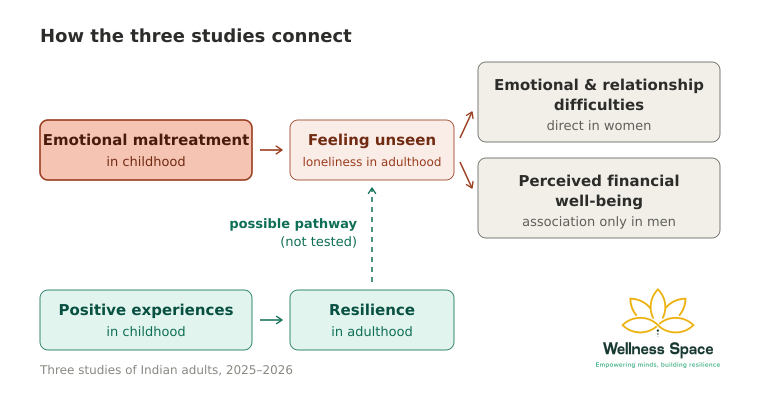
We asked what predicted it. Childhood emotional maltreatment — emotional abuse and emotional neglect, the kind that leaves no visible mark — was significantly associated with loneliness. Together with depression and loneliness, the model accounted for half the variation in DSO symptoms.
What struck me was the role of loneliness in depression. In our model, childhood emotional maltreatment was not directly associated with depression once loneliness was included. Instead, the association appeared to operate primarily through loneliness. Emotional neglect in childhood was linked to depression in adulthood largely by way of the loneliness it produced along the way.
This reframes the sequence. A child who grows up feeling emotionally unseen, criticized rather than comforted, accepted only when meeting expectations, learns to hide. Some become invisible. Others build an outgoing, entertaining persona that does the same job. These are intelligent adaptations to a difficult environment. They also become, decades later, the exact barriers to intimacy and trust that keep an adult lonely in a full house.
Long before adulthood, the child has learned what relationships cost. The adult is still paying.
Where loneliness shows up
The second study had nothing to do with trauma. We surveyed 311 urban adults about their financial well-being — could they handle an unexpected expense, did they feel on top of day-to-day finances, were they on track for the future (Trivedi, Pabari, Trivedi, & Baxi, 2026).
We measured the obvious things: financial resources and financial capability. Both mattered strongly, as anyone would predict. But we also put loneliness into the model, mostly to see what would happen. The rationale was simple: financial well-being is partly subjective. Two people with similar resources can experience their financial situation very differently.
Loneliness was negatively associated with financial well-being. And the association held in men but not in women. Among men, the lonelier they were, the worse they felt about their financial lives, even after accounting for actual resources and financial skill.
I want to be careful here. The findings should also be interpreted in light of the urban and relatively educated nature of the samples. But the finding is worth sitting with. Financial well-being is not the same as financial resources, a distinction Kahneman and Deaton (2010) made in a different form when they showed that income improves how people evaluate their lives long after it stops improving how they feel day to day. Two men with identical income, identical savings and identical financial literacy can feel very differently about their money. One predictor of that gap appears to be whether they feel known by anyone.
Money is where a great deal of male anxiety goes to live. In a culture that still assigns men the role of provider and gives them very little permission to name emotional distress, “I am worried about money” may be one of the few socially available ways to say “something is wrong.”
The part I can’t fully explain.
Here is where it gets genuinely interesting, and where I would rather be honest than tidy.
The two studies show opposite gender patterns.
In the trauma study, loneliness directly predicted disturbances in self-organization in women. In men, loneliness only mattered indirectly; it influenced DSO through depression. Loneliness alone, without depression, did not appear to move the needle for men.
In the financial study, loneliness predicted financial well-being in men. Not in women, whose financial well-being tracked only resources and capabilities.
To be clear, these are different samples, different outcomes, different instruments. And they do not contradict. A finding about trauma symptoms and a finding about subjective financial well-being are simply not what we claimed. The key is the pattern that suggests loneliness may not be weaker in men so much as redirected within behavioural patterns. It could surface where expression is permitted. In the psychological domain, men’s loneliness appears to need depression as an intermediary before it registers. In the financial domain, it registers directly.
Loneliness may not be weaker in men so much as rerouted. It surfaces where expression is permitted.
Evidence on gender and loneliness is genuinely mixed — Barreto and colleagues (2021), surveying loneliness across cultures, found men reporting higher loneliness than women in many contexts, while earlier work found the reverse. Much of the difference may be about willingness to report rather than the experience itself. The existing Indian literature is so thin that I can describe this pattern but cannot confidently explain it. That is a limitation, and also, I think, the most useful thing in either paper: a well-specified question for someone to answer next.
What this changes
Most loneliness interventions tell people to socialise more. Join a group. Get off your phone. Call a friend.
These are worthwhile, and I would not discourage any of them. But for someone whose nervous system learned early that closeness is unpredictable, adding social contact does not reduce loneliness. It can increase it — more rooms full of people who don’t know you.
Adding social contact does not reduce loneliness. It can increase it — more rooms full of people who don’t know you.
If loneliness has roots in childhood emotional safety, then prevention lives upstream, in how we raise children and in how much of our own unprocessed history we bring to that work. When a child grows up around adults who stay calm amid chaos and who help them navigate difficult emotions rather than punishing them for having emotions, the child learns that being known is safe. For that to happen, the adults must have done some work on themselves.
There is a hopeful counterpart to all of this. In a separate study we recently conducted with 347 Indian adults, positive childhood experiences- a caregiver you could confide in, a trusted adult, a sense of belonging, and predictability at home- were independently associated with adult resilience, even after accounting for childhood adversity (Trivedi, 2026). What went right mattered, not simply as the absence of what went wrong.
That study did not measure loneliness, so what follows is an inference. If emotional neglect teaches a child that being known is unsafe, positive childhood experiences may teach the opposite lesson. Whether that lesson specifically protects against adult loneliness is a question I would like to test next.
This is not about blaming parents. Most caregivers do their best with the emotional resources they were handed. The point is that emotional patterns pass from one generation to the next — and that they can be interrupted.
And if loneliness shows up in domains we don’t code as emotional, in how a man feels about his savings, in whether an adult can regulate her emotions, then screening for it belongs in more places than we currently put it. Financial counsellors, clinicians and educators are all, some of the time, looking at loneliness without a name for it.
India has a large working population under 35. Investing in children’s emotional well-being is a mental health priority and a long-term economic one.
Instead of asking only “Why am I lonely?”, it may be worth asking: “When did I first learn that I had to face my feelings alone?”
For a lot of people, that question is more useful, and considerably kinder.
Gunjan Y Trivedi is a co-author of What Happened to Me? vs What’s Wrong with Me? Indian Perspectives on Childhood Trauma and Recovery (Penguin Random House India).
Additional perspective
References
Barreto, M., Victor, C., Hammond, C., Eccles, A., Richins, M. T., & Qualter, P. (2021). Loneliness around the world: Age, gender, and cultural differences in loneliness. Personality and Individual Differences, 169, 110066. https://doi.org/10.1016/j.paid.2020.110066
Holt-Lunstad, J., Smith, T. B., Baker, M., Harris, T., & Stephenson, D. (2015). Loneliness and social isolation as risk factors for mortality: A meta-analytic review. Perspectives on Psychological Science, 10(2), 227–237. https://doi.org/10.1177/1745691614568352
Kahneman, D., & Deaton, A. (2010). High income improves evaluation of life but not emotional well-being. Proceedings of the National Academy of Sciences, 107(38), 16489–16493. https://doi.org/10.1073/pnas.1011492107
Trivedi, G., Pandya, N., Thakore, P., Ramani, H., & Patel, N. (2026). A structural equation modelling approach to understand the associations between childhood emotional maltreatment, loneliness, depression and disturbances in self-organization at a wellness centre in India. International Journal on Child Maltreatment: Research, Policy and Practice, 9(1), 107–128. https://doi.org/10.1007/s42448-025-00249-9
Trivedi, G. Y., Pabari, R., Trivedi, A., & Baxi, C. (2026). Are lonely men unhappy financially? Gender differences in factors associated with financial well-being. Journal of Financial Counseling and Planning. https://doi.org/10.1891/JFCP-2024-0096
Trivedi, G. Y. (2026). Positive childhood experiences are independently associated with adult resilience after accounting for adverse childhood experiences: A cross-sectional study in India. Acta Psychologica, 267, 107028. https://doi.org/10.1016/j.actpsy.2026.107028 (Open access)
Trivedi, G. Y., & Trivedi, R. G. (2025). Why some people feel lonely even when they are loved. The Hindu. https://www.thehindu.com/society/healthwhy-people-feel-lonely-even-when-loved/article71276307.ece
Trivedi, G. Y., & Trivedi, R. G. What happened to me? vs what’s wrong with me? Indian perspectives on childhood trauma and recovery. Penguin Random House India.